
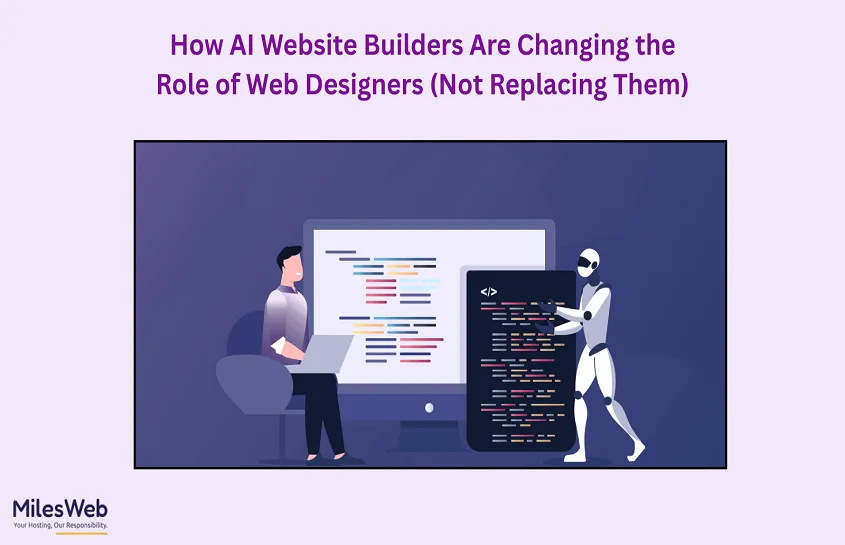
Artificial Intelligence (AI) has transformed the web development process. It powers website builders to create layouts, write content, and even recommend SEO enhancements in minutes. Example is Indian AI website builder. Despite all the advancements, AI is not replacing human creativity but improving it.
Instead of eliminating the designer’s requirement, AI tools along with low-price domain change the work functionalities. Designers are evolving into creative strategists, combining technical knowledge with user empathy, brand insight, and design intuition that machines don’t replicate. Let’s explore how AI is reshaping the designer’s role for the better.
From Manual Design to Creative Direction
Conventional web design involved many coding hours, prototyping, and layout tweaking. As AI handles the repetitive tasks, designers can easily focus on storytelling, usability, emotional impact, and graphic elements that bridge and emotional connection with audiences.
AI streamlines the technical layer and still needs the human’s touch to interpret brand identity, tone, and values. Instead of building pixel by pixel, designers can act as creative directors, overseeing brand consistency and aesthetics.
AI as a Collaborative Tool, Not a Competitor
Instead of viewing AI as an adversary, web designers view it as a partner. Artificial intelligence (AI) software plays a role in developing wireframes and color schemes, analyzing user behavior, and designers can then further develop and refine anything AI generates with their experience.
This can help combat creative fatigue while also increasing productivity, and with it, the pace of design projects at the intersection of automation and creativity, AI does the what, while humans and designers do the why.
Personalized Design through AI Insights
AI website builders evaluate user data, demographics, and behavioural trends to create designs more individualized for their online experience. Transforming data into meaningful visual communication requires a designer’s understanding of human behaviour.
Designers can take insights created by AIs and build experiences that feel relevant, engaging, and trustworthy. The result: A website that is pleasing to look at, provides users what they wish, and meets business needs.
Smarter Prototyping and Testing
Before AI, prototyping and A/B testing were time-consuming processes. AI simulates the user interactions and predicts engagement patterns that reduce the time of auto testing and multiple designing versions simultaneously.
Designers use this data to make evidence-based decisions instead of relying only on intuition. It is an easier, faster, and easier way of ensuring every design resonates with the intended audience.
Automation of Repetitive Design Tasks
AI can automate repetitive, low-value tasks like resizing images, adjusting spaces, and ensuring mobile responsiveness. Designers can focus on conceptual work, innovative layouts, and creative experimentation with this automation.
As a result, there is less burnout and additional creativity. Instead of spending hours on tedious revisions, designers can focus on ideation and user experience.
Enhanced Accessibility and Inclusive Design
AI tools could help provide a set of recommended contrast ratios, font sizes, and navigation patterns to build accessible websites. However, human designers must work alongside the AI tools to create authentic, inclusive experiences.
Ultimately, these AI tools lack the ability to replace human expertise with less empathy or cultural awareness. It is necessary to allow accessibility to emerge in ways that embody true brand values.
Evolving Skills for the AI-Driven Future
The integration of AI into workflows will evolve web designers into hybrid professionals. They now combine creative direction with data literacy, UX strategy, and management of AI tools.
Their evolution means they will only grow in value and not be obsolete. To effectively direct AI to accomplish work will be a second superpower for each designer, allowing designers to deliver more impact in their data-driven work.
Conclusion
AI website builders are web-designing assistants for designers. They redefine the purpose by eliminating repetitive work. AI enables visionary website designers who focus on storytelling and the user’s empathy.
In the future, effective web design will be based on a duality operating between machine efficiency and human creativity. Although an AI can create a website, only a designer can impart meaning. True innovation is in the relationship between humans and AIs that create an experience that is intelligent, quick, and human.